




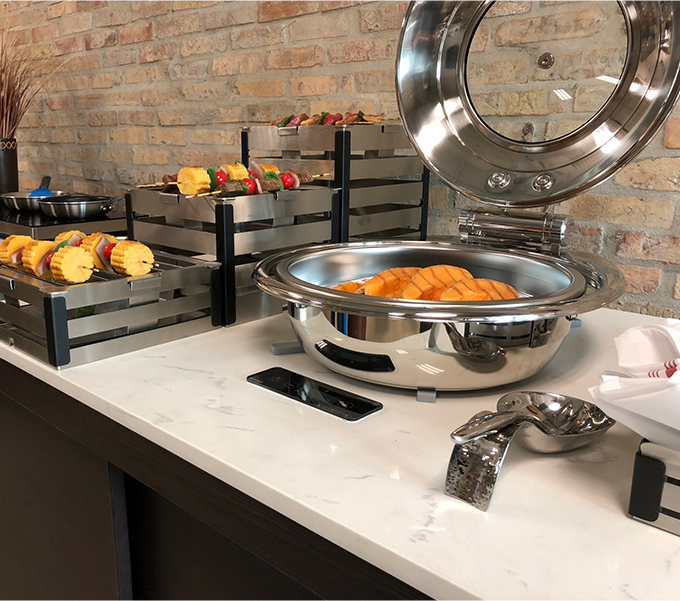
L'induction, une technologie qui respecte les normes d'hygiène en cuisine pro
L'obligation de propreté, la prévention des contaminations et la maîtrise des risques bactériologiques sont autant d'impératifs en cuisine professionnelle. Pour concilier ces exigences sanitaires à la performance opérationnelle, de nombreux restaurateurs, hôteliers et traiteurs adoptent désormais l'induction.
Sans brûleur ni flamme, la plaque à induction limite fortement les projections de graisses et d'aliments carbonisés. Sa surface lisse en vitrocéramique simplifie le nettoyage et réduit les zones d'accumulation où les bactéries pourraient se développer. De plus, la chaleur étant générée directement dans le récipient, la diffusion thermique dans l'air est considérablement réduite. La cuisson génère alors moins de condensation, de vapeur et de particules. Souvent responsables d'encrassement, ces résidus imposent généralement des cycles d'entretien rigoureux ; l'utilisation de l'induction permet d'en réduire la fréquence et l'intensité.
Comment la cuisson par induction améliore-t-elle la sécurité du personnel en cuisine ?
Garantir un environnement de travail sain et sécurisé est une obligation légale pour les professionnels, mais également un impératif de performance. L'aménagement des locaux, la ventilation, l'hygiène des postes et, surtout, la conformité du matériel sont indispensables. Sur ce dernier point, les plaques à induction sont une solution particulièrement fiable. Leur utilisation élimine les risques de :
- Incendie ;
- Fuites, voire d'explosion dans un espace clos (liés à l'utilisation du gaz) ;
- Brûlures accidentelles et stress thermique ;
- Excès de chaleur ;
- Incidents générés par les combustibles.
Les appareils professionnels intègrent par ailleurs des dispositifs de sécurité avancés : détection automatique du récipient, arrêt immédiat en cas d'absence de contact, contrôle électronique précis de la température, boutons d'arrêt d'urgence… Autant de fonctionnalités qui sécurisent les manipulations quotidiennes et préviennent les accidents.

Technologie de l'induction, réglementations thermiques et efficacité énergétique : tout ce qu'il faut savoir
Au-delà des normes d'hygiène et de sécurité, les cuisines professionnelles sont soumises à des contraintes thermiques et environnementales. Grâce à son rendement élevé, l'induction est une solution particulièrement avantageuse, tant en termes de performances que d'économies d'énergie.
Un rendement énergétique jusqu'à 90-95 %
Les équipements à induction transfèrent directement l'énergie au récipient, ce qui limite significativement les déperditions thermiques. Les modèles les plus performants atteignent souvent un rendement supérieur à 90 % lorsque les conditions sont optimales.
Moins de chaleur ambiante, moins de ventilation nécessaire
Les plaques à induction émettent une très faible quantité de chaleur ; les bénéfices se ressentent immédiatement sur la charge imposée aux systèmes d'extraction et de ventilation. Pour les établissements professionnels, cela se traduit par :
- Une diminution de la consommation énergétique ;
- une amélioration du confort thermique ;
- le respect des normes de travail liées à la température en cuisine.
Une technologie durable et peu sujette à l'usure
Dépourvus de flammes, de pièces mécaniques exposées à la combustion et équipés de composants électroniques protégés, les équipements à induction s'usent moins vite. Les pannes et dysfonctionnements se font ainsi plus rares et les coûts de maintenance sont moins élevés sur le long terme.
Flexibilité, rapidité et rentabilité des systèmes à induction Adventys
Les cuisines professionnelles riment souvent avec des rythmes intenses, des pics d'activités et une organisation en constante évolution. La gamme d'équipements de cuisson Adventys est une solution modulable, capable de s'adapter à diverses attentes et contraintes.
Une rapidité d'exécution incomparable
Dès l'activation du champ magnétique, les plaques à induction montent en température instantanément. Cette réactivité optimise la cadence de production, particulièrement lors des services soutenus ou dans les concepts de restauration rapide.
Une flexibilité qui facilite l'organisation des postes
Fixes, encastrées, portables ou intégrées dans des buffets : les solutions à induction Adventys s'adaptent à absolument tous les types d'environnements. Il est alors possible de reconfigurer les postes selon les besoins, sans engager de travaux lourds ni s'exposer à des contraintes d'alimentation complexes.
Une rentabilité opérationnelle exceptionnelle
Moins d'énergie consommée et de chaleur perdue, rapidité de cuisson, maintenance réduite… Ce sont autant d'avantages qui font de l'induction Adventys un atout de rentabilité non négligeable pour les professionnels.
Bien plus de bénéfices pour les professionnels
En plus de leurs performances, les équipements Adventys sont fabriqués en France, ce qui garantit une traçabilité complète de chaque composant. L'entreprise conçoit également ses propres cartes électroniques, dans le but de garantir la fiabilité de chaque appareil et faciliter leur maintenance dans le temps. Grâce à un bureau d'études interne, le groupe développe chaque année de nouveaux produits pour répondre aux évolutions du secteur et aux contraintes des professionnels.
Induction et conformité : un choix stratégique pour les cuisines professionnelles
L'induction répond scrupuleusement aux impératifs de sécurité, d'hygiène, d'efficacité énergétique, de flexibilité et de rentabilité imposés aux cuisines professionnelles. Elle garantit un haut niveau de sécurité, réduit les déperditions thermiques et promet une hygiène irréprochable, conditions essentielles pour se conformer aux réglementations en vigueur.
Cette technologie n'est donc plus un simple atout pour les restaurateurs et chefs exigeants, mais un choix stratégique qui conditionne le niveau de performance. Si les bénéfices de l'induction ne font plus débat, le choix du matériel est déterminant pour garantir la conformité réglementaire et optimiser durablement les résultats.